
If you’ve ever woken up with a stiff neck or that “stuck” feeling in your lower back, you already know how annoying it gets. First you avoid turning your head. Then you start sitting weird. After that, even a small task—like tying your shoes—feels like work.
Now, pain relief matters, of course. However, long-term comfort usually needs more than a quick fix. That’s where Ayurveda for back pain and Ayurveda for neck pain can help. Ayurveda doesn’t look only at the “spot that hurts.” Instead, it looks at your daily routine, your digestion, your stress level, your sleep, and even how dry or tense your tissues feel.
At MATT INDIA AYURVEDA, many people come in with desk-job stiffness, travel fatigue, old sports strain, or stress-built tightness. Some people also come with recurring episodes—pain goes away, then comes back again. So, let’s break down a simple, practical—way to approach Ayurveda for spine-related discomfort, especially with 3 popular therapies: Abhyanga, Kizhi & Kati Basti.
Why Ayurveda Often Connects Back/Neck Pain With Vata
In Ayurvedic terms, pain and stiffness are often symptomatic of Vata aggravation. Movement is governed by Vata – joint motion, muscle movement, nerve flow and circulation. If Vata becomes imbalanced, you might feel:
- dryness and cracking in joints
- stiffness that feels worse in cold weather or AC
- spasms, pulling pain, or “catching” while bending
- pain that’s worse at night or early morning
- restlessness and disturbed sleep (which then makes pain feel stronger)
At the same time, not all pain is pure Vata. Sometimes inflammation shows up too—heat, burning—sensation, tenderness/swelling. That’s where Pitta can join the picture. So, a good approach first asks: is your pain mostly stiff/dry/tight (Vata-type) or hot/tender/inflamed (Pitta-type), or a mix? Get Kerala Ayurveda Packages.
Step 1: Start With a Proper Assessment (Instead of Random Treatments)
It’s tempting to pick one trending—therapy & hope it works. But Ayurveda works best when the therapy matches your pattern.
A practitioner will usually check things like:
- exact location (neck, shoulders, upper back, lower back, sacrum)
- pain nature (dull, sharp, burning, radiating)
- triggers
- digestion
- sleep quality and daily energy
- old injuries and posture habits
Because of that, your plan may focus on calming Vata, reducing inflammation, clearing “Ama”/building—tissue strength—sometimes all of the above, in stages.
Step 2: Use the Right Trio in the Right Order
1) Abhyanga (Warm Ayurvedic Oil Massage)
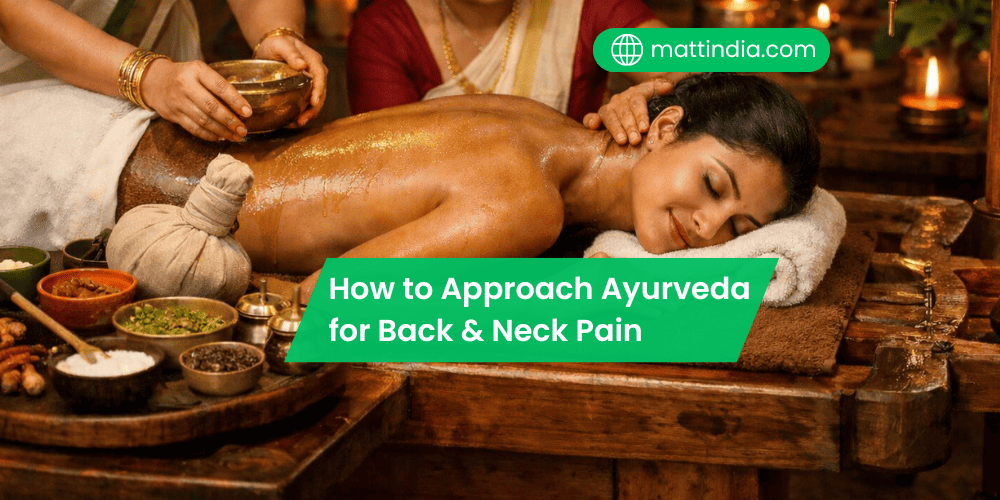
Abhyanga is one of the best starting points for many people with stiffness. It’s a warm oil massage using medicated oils chosen for your condition.
Why it helps
- It relaxes tight muscles and fascia.
- It improves local circulation, so tissues feel more “alive.”
- It calms the nervous system (and that matters more than people think).
- It reduces the “dry, stuck” feeling linked with Vata.
What it feels like
Most people describe it as deeply grounding. Also, when you’re stressed, your shoulders stay raised without you noticing. Abhyanga helps the body “drop” that tension. Get Kerala Ayurvedic Treatments.
After Abhyanga, you may notice
- neck rotation feels easier
- shoulders feel lighter
- sleep improves (and then pain sensitivity drops too)
2) Kizhi (Herbal Bolus Therapy / Pinda Sweda)
After oil massage, Kizhi brings warmth and herbal action directly into stiff areas. The therapist uses small cloth boluses filled with herbs/leaves/powders and applies them in a rhythmic way.
Why Kizhi works so well
- warmth improves circulation fast
- it reduces stiffness and spasm
- it helps “open” tight tissue layers
- it supports mobility, especially for neck and upper back tightness
Common types
- Elakizhi (Patra Pinda Sweda): herbal leaf bolus; great for muscular tightness, stiffness, and joint discomfort
- Podikizhi (Churna Pinda Sweda): herbal powder bolus; often used for heaviness, swelling, and stubborn pain. Get Kerala Ayurveda Rejuvenation Packages.
3) Kati Basti (Warm Oil Pooling for the Lower Back)
If your main trouble sits in the lumbar area, Kati Basti can be a game changer. The therapist makes a dough ring on the lower back and holds warm medicated oil inside it for a set time.
Why it helps
- it deeply relaxes lumbar muscles
- it nourishes and lubricates local tissues
- it reduces the tight, compressed feeling
- it supports recovery from long sitting, driving, or repeated strain
What to expect
- a dough ring placed on the lower back
- warm oil maintained at a steady temperature
- oil refreshed to keep warmth consistent
- treatment typically 20–30 minutes
Step 3: Match Therapy With Your Pain Type
This part is simple, yet powerful.
If your pain feels stiff, dry, tight (classic Vata)
- Abhyanga + Kizhi often comes first
- Kati Basti may be added if lower back is the main issue
- warm routine + sleep support becomes essential
If your pain feels hot, inflamed, tender (Pitta involvement)
- oils and herbs are chosen carefully
- heat therapies may still be used, but in a controlled way
- diet and cooling routine matter more than you expect. Get Kerala Ayurveda Joint Care Package.
Step 4: Simple Home Support That Makes Treatments Work Faster
Clinic therapies help a lot. However, daily habits decide how long the relief lasts.
Daily routine tips
- Keep your neck and lower back warm, especially in AC.
- Take breaks from sitting every 30–45 minutes.
- Avoid sudden heavy lifting when your back feels tight.
- Use a supportive pillow (not too high).
- Walk daily, even 15–20 minutes. It keeps the spine happier.
Food tips (easy, realistic)
Choose—warm, easy-to-digest foods:
- soups, stews, khichdi, cooked—veggies
- a little ghee (if your digestion handles it)
- warm water through the day
Reduce:
- ice cold drinks
- dry snacks and too much caffeine
- late-night heavy meals (they disturb sleep and increase stiffness)
Also, constipation often increases back discomfort. So, regular digestion matters more than people think.
Related Articles:
» Ayurvedic treatment to cure Chronic Back Pain
» Treating the Back Pain using Ayurveda
» Joint and Muscle Pain Management: An Ayurvedic Perspective
» Ayurveda Treatment for Lower Back Pain
» Natural Pain Relief through Ayurvedic Therapies
What a Practical Therapy Plan Can Look Like
Every person is different, still many people follow a pattern like:
Phase 1 (Release & calm): Abhyanga + Kizhi to reduce stiffness and spasms
Phase 2 (Target & support): add Kati Basti if lumbar pain is dominant
Phase 3 (Maintain): home routine + periodic sessions + gentle strengthening
Some clients feel lighter after 1–3 sessions, especially when the issue is mostly muscular. Meanwhile, chronic pain may take longer because tissues need time to recover. The key is consistency, not speed.
When You Should Be Extra Careful
Ayurvedic—therapies are generally safe when trained professionals handle them. Still, you should inform your practitioner if you have:
- fever or active infection
- open wounds or skin rashes in the therapy area
- severe radiating pain with weakness or numbness
- uncontrolled diabetes or severe circulation issues
- pregnancy (certain therapies need modification)
FAQs on “How to Approach Ayurveda for Back & Neck Pain”
Yes, Ayurveda for chronic back pain is effective in decreasing stiffness, pacifying Vata, and increasing blood circulation to the area as well as feeding it tissues — especially with Abhyanga, Kizhi, and Kati Basti.
Often Abhyanga + Kizhi works well because it relaxes—muscles & improves movement. However, the best choice depends on whether your pain is dry/stiff/hot/tender.
Abhyanga helps by relaxing tight muscles, improving circulation & calming the nervous—system. That calming effect reduces pain sensitivity too.
It shouldn’t. It should feel—warm & relieving. If it feels too hot/uncomfortable, the therapist must adjust the heat & pressure.
It depends on how long you’ve had pain & how your body responds. Many people take a short course of sessions for best results
It may support stiffness & discomfort in non-emergency cases. But if you have severe weakness, major numbness/bowel/bladder symptoms, please seek urgent—medical care first.
Yes, gentle self-massage with warm—oil helps. Still, professional—therapy often gives deeper relief, especially for stubborn pain.
It can support muscle tightness and Vata-related radiating discomfort. A proper assessment matters because causes differ from person to person.
A little rest helps. Also, avoid cold showers and heavy workouts right after therapy so the body holds the benefit.
Avoid cold exposure, cold—drinks, late-night meals & intense exercise immediately after treatment.
Yes, especially in Ayurveda. Poor digestion, dryness & irregular—routine can increase Vata & stiffness. So, diet support often improves results.
Some people feel relief quickly (within a few sessions). Chronic cases take longer. However, consistent therapy plus routine changes usually brings steady improvement.