

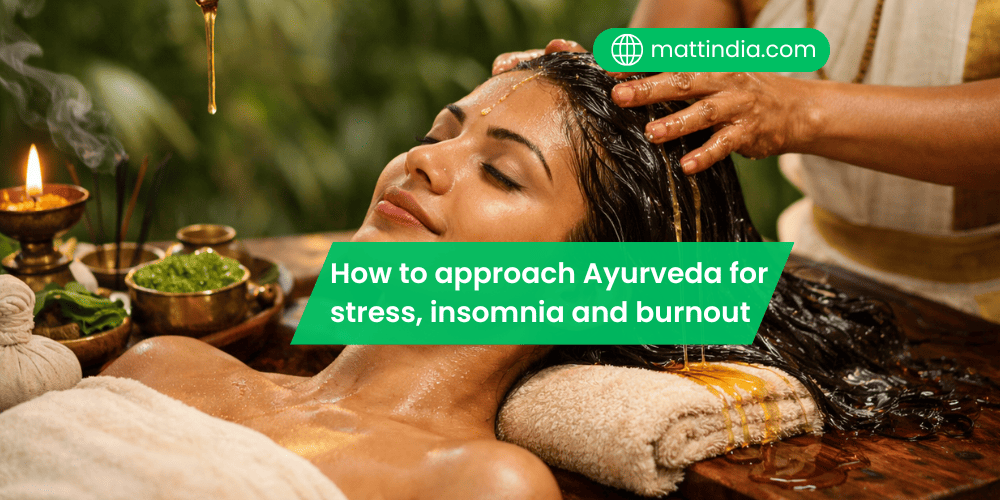
Some days, stress doesn’t feel like “a problem.” It feels like your default setting. You wake up tired, you power through the day at work and then your brain won’t shut off at night. After a time, sleeplessness enters the picture, and then burnout quietly follows — you have less passion, less patience, less joy.
Ayurveda views this in a very practical manner. Rather than addressing stress, sleep and fatigue as three separate problems, it poses a single key question: what’s throwing your system off balance—and how do we bring it back gently?
This guide will explain to you how to do Ayurveda for stress relief, Ayurveda for insomnia and Ayurvedic burnout recovery in the most practical, no-nonsense way possible—without doing anything extreme.
Health note: If your case of insomnia is severe, if you’ve felt depressed for weeks, if you’re having panic attacks or on strong medicines, please see a knowledgeable doctor and an Ayurvedic practitioner who can help guide the use of herbs or major changes.
Why Ayurveda links stress, insomnia, and burnout together
In Ayurveda, your body and mind are linked through doshas: Vata, Pitta and Kapha, in particular. If you’re under pressure long enough, one or more doshas may become aggravated and then symptoms start to stack up.
- Stress tends to activate Vata (over-thinking, restless) or Pitta (anger, heat, intense).
- Insomnia can come from the same imbalance: either a busy, racing mind (Vata) or a sharp, “can’t stop planning” mind (Pitta).
- Burnout is frequently what happens after a few weeks or months of running on adrenaline.
So the idea is not to “knock yourself out” to sleep. The goal is to calm the system, improve daily rhythm, and rebuild energy from the inside out. Get Kerala Ayurveda Stress Management Package.
Step 1: Understand your stress pattern
Ayurveda works best when it’s personal. Two people can say “I’m stressed” and mean completely different experiences.
For 3–5 days, just notice:
- When anxiety rises (morning? evening? after work calls?)
- When your energy drops
- Your digestion (acidity, gas, constipation, loose stools)
- Your sleep (time you fall asleep, wake-ups, dreams)
- Your screen time at night (this matters more than we want to admit)
Quick dosha clues (simple version)
- Vata imbalance: racing thoughts, dry skin, constipation, cold hands/feet, light fitful sleep.
- Pitta imbalance: heat, irritability, heartburn, night sweats and waking up in the middle of the night with a “busy” mind.
- Kapha imbalance: feeling heavy, lack of motivation or ambition, too much sleep, sluggishness and mental fog.
You don’t have to identify yourself perfectly. Even noticing a few patterns lets you choose the right steps. Get Kerala Ayurveda Joint Care Package.
Step 2: Start with routine (it sounds boring, but it works)
Ayurveda attaches tremendous importance to Dinacharya- daily routine-because the nervous system relaxes with regularity. When life is chaotic, routine is like a handrail.
Here’s a simple foundation:
|
Time |
What to do |
Why it helps |
|
Morning |
Wake up around the same time |
Supports natural sleep cycle |
|
Morning |
Warm water (plain) |
Settles Vata, supports digestion |
|
Afternoon |
Make lunch the main meal |
Steadier energy, better digestion |
|
Evening |
Lighter dinner, not too late |
Reduces night restlessness |
|
Night |
Same wind-down routine daily |
Trains the brain to slow down |
Even if you only follow 2–3 points, it can still reduce the “wired” feeling within days.
Step 3: Fix the evening first (sleep begins before bedtime)
A lot of people try to solve insomnia at 11:30 p.m. But your body began preparing for sleep much earlier — and if the evening is loud, then sleeping becomes difficult.
Try a calmer evening window (45–60 minutes before bed):
- Lower the lights
- Reduce scrolling and constant messaging
- Don’t listen sensational news or have late-night discussions.
- Maintain your room frigid, tranquil, and uncluttered
It’s not about perfection. It’s about giving your mind fewer reasons to stay alert. Get Kerala Ayurveda Anti-Aging Package.
Step 4: Try Abhyanga (Ayurvedic oil massage) for a calmer nervous system
This is one of the most loved Ayurvedic practices for stress and sleep. It’s easy, it’s comforting and remarkably potent.
How to do it (easy version)
- Rub a small bit of oil in palms
- 5-10 min rub feet, calves, hands, and head
- Wipe off excess (or shower quickly if you prefer)
Which oil?
- If you feel anxious, dry, restless → sesame oil often suits (warming, grounding)
- If you feel hot, irritated, angry at night → coconut oil can feel more cooling
If oil massage feels “too much,” start with only the feet. Foot massage alone can change sleep quality for many people. Get Abhyanga Ayurvedic Oil Massage.
Step 5: Eat for calm (not for rules)
Ayurveda connects sleep and stress strongly with digestion (Agni). When digestion is disturbed, sleep often gets disturbed too—either through discomfort, heat, bloating, or that uneasy “not settled” feeling.
Gentle food shifts that support sleep
- Choose more warm cooked meals (especially if you feel Vata symptoms)
- Reduce late-night heavy food (fried foods, large portions, sweets at midnight)
- If you have acidity or heat, reduce very spicy dinner
- Limit caffeine after midday if you struggle to sleep.
Forget dieting and think: simple food, warm food, regular times.
Step 6: Breathwork that actually feels doable
You don’t need complicated meditation to start. The nervous system responds quickly to slow breathing.
A simple method: 4–6 breathing
- Inhale for 4 counts
- Exhale for 6 counts
- Do it for 3–5 minutes
Longer exhale is like telling your body, “You can relax now.”
And if your mind is looping, also add on a brain dump to pen and paper — write out everything stuck in your head. No neatness needed. Get Kerala Ayurveda Therapy.
Step 7: Ayurveda herbs for stress, insomnia, and burnout (use them carefully)
Yes, Ayurveda does include widely accepted herbs, but it is more prudent to introduce them under careful guidance. Herbs can act on the hormones, on digestion, sleep cycles — and sometimes against prescription drugs as well.
Some herbs common to Ayurveda for stress/sleep support are:
- Ashwagandha (often used for stress resilience)
- Brahmi (traditionally for calming the mind and focus)
- Jatamansi and Tagara (traditionally used for sleep support)
Still, don’t self-prescribe if you’re pregnant or breastfeeding; have thyroid problems or an autoimmune disease; or are on antidepressants/sedatives. The wrong match is avoided with a proper consultation.
At MATT INDIA AYURVEDA, the best approach is usually:
- assess your dosha pattern, digestion, and sleep type
- build routine + food support
- then choose herbs only if needed, and in the right form and dose
Related Articles:
» Ayurveda Therapy for Stress Management
» The Stress Relief Therapies Using Ayurveda
» Managing stress with Ayurveda
» Panchakarma for Stress Relief: A Natural Solution
» Does Ayurveda therapy overcome stress?
Step 8: Burnout recovery = rebuilding Ojas (your deep reserve)
Burnout is not only “too much work.” It’s often too much output with not enough recovery.In Ayurveda, the endurance for the long haul is associated with Ojas—your deep and abiding energy, immunity and emotional strength.
To support Ojas, focus on:
- Sleep timing (even if sleep quality takes time)
- Nourishing meals (not skipping meals, not surviving on snacks)
- Gentle movement (walking, yoga, stretching)
- Real breaks (not only screen breaks)
- Boundaries (work ends at some point—your body needs that signal)
Burnout improves when your day stops feeling like a constant emergency.
A simple Ayurvedic plan (that you can actually follow)
If you want something structured:
Week 1: consistent wake time + warm meals + lighter dinner
Week 2: add nightly wind-down + 4–6 breathing
Week 3: add Abhyanga (or foot massage) 3–4 nights/week
Week 4: consult for personalised herbal support if needed
Small steps done daily beat big steps done once.
FAQs on “Ayurveda for stress, insomnia and burnout”
Ayurveda can help with sleep by being a soothing influence to the nervous system and bettering rhythm, digestion and habits of living.
Vata and pitta are generally increased by stress, but it manifests based on the individual.
Routine bedtime and wake up, hot dinners, early post-dinner light snack and winding down habits.
For many, yes — especially for Vata-type restlessness. Even foot massage can help.
Sesame oil is heating and rooting. Coconut oil may be beneficial for heat and irritation.
Some people do, but it depends what your health status is and what medications you are taking.” Consult a practitioner for safety.
Since an imbalance in digestion can cause discomfort, heat, bloating and disruption to the nervous system at night.
Eating very large meals late at night, too much caffeine and alcohol, highly spiced foods and sweet snacks in the evening can disrupt sleep.
Some people see little changes in days; but recovery from burnout frequently takes a number of weeks up to several months.
It may be due to stress, Pitta imbalance, digestion or lifestyle. If it is frequent, check medical causes as well.
Usually, but herb–drug interactions can occur. Always provide your medication history to your provider.
If you have severe anxiety, depression, suicidal thoughts, chest pains, extreme fatigue or persistent insomnia that affects daily life.